Carl W. Peters
Elm Street, Rochester, NY. 1932
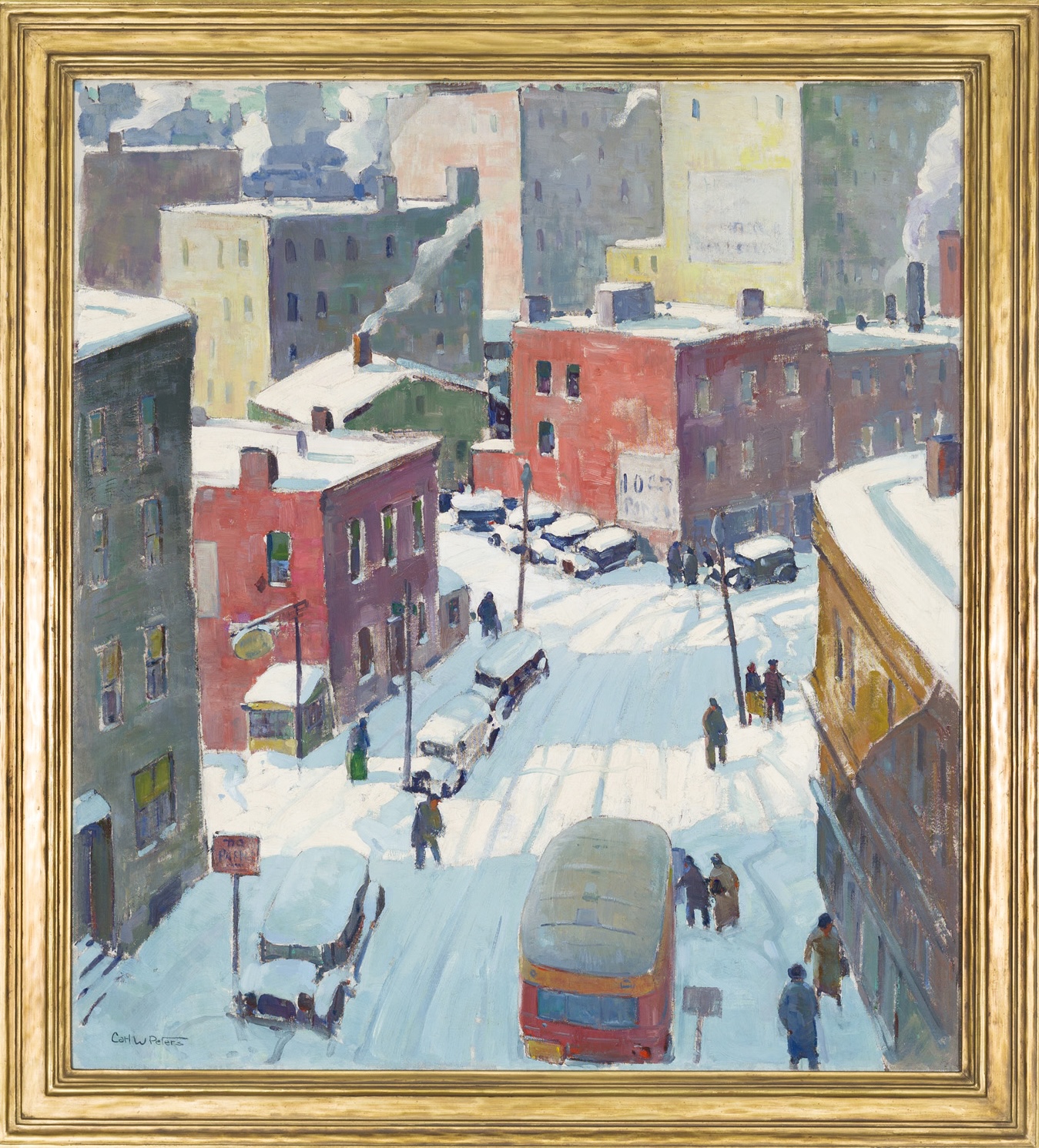
Carl W. Peters (1897–1980). Elm Street, Rochester, NY. 1932. Oil on canvas. 40 x 32 in. The Marty O’Brien Collection of American Art.
Carl W. Peters was a regional American artist whose work reflects a sustained engagement with place, community, and the cultural identity of upstate New York in the early twentieth century. Born in Fairport, NY, Peters was shaped by both local experience and formal training. He studied at the Mechanics Institute in Rochester, which is now Rochester Institute of Technology, before continuing at the Art Students League in New York City, where he encountered both impressionist and realist traditions. During his training, including time at the Art Students League’s summer school in Woodstock, Peters was exposed to the teachings of Robert Henri and the influence of the Ashcan School. This dual training informed a practice that remained grounded in observation while attentive to atmosphere and the lived conditions of everyday life. After his studies, Peters returned to Rochester in 1921 and became part of a broader network of artists invested in representing American life through regional subject matter. His work aligns with the American Scene movement, which sought to elevate local environments and experiences as central to national identity.
[…] her work sustains tension—between the ornate and the restrained, the innocent and the erotic—allowing contradiction to function as a structural condition.
After completing her studies, Lucas moved to Manhattan in 1979. By the 1980s, she became actively engaged with the downtown New York, Lower East Side gallery scene, exhibiting at spaces including the Avenue B Gallery, a defining fixture of the East Village art scene during its heyday and host of landmark shows such as East Village ’86. During this period, she also formed close personal and professional connections, including a lasting friendship with Sylvia Wald, which shaped both her career and her engagement with the local art community.

Carl W. Peters (1897–1980). Detail of Elm Street, Rochester. 1932.
In this depiction of Elm Street, Peters positions the viewer within a working city where commercial buildings, storefronts, and pedestrian activity define the space. A winter atmosphere fills the composition, with the muted tones of shadows offset by sunlight and reflections. This attention to winter light and atmosphere reflects Peters’s commitment to working directly from observation, at times sketching on site even in severe weather conditions in order to capture the immediacy of the scene. His brushwork balances structural precision with texture and gentle color modulation which highlights his technical training. The balanced perspective emphasizes human presence within the built environment, suggesting both quiet dignity and the routine movement of daily life. Peters’s careful approach to this scenery aligns with contemporaries such as Charles Burchfield and Grant Wood who elevated local landscapes and street scenes to national significance.
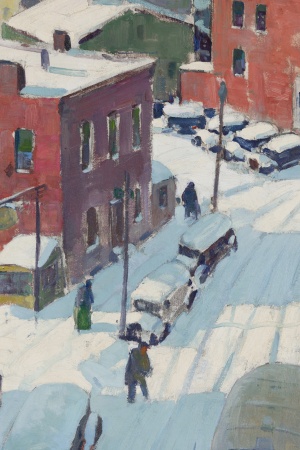
Carl W. Peters (1897–1980). Detail of Elm Street, Rochester. 1932.
The balanced perspective emphasizes human presence within the built environment, suggesting both quiet dignity and the routine movement of daily life.
Peters exhibited widely throughout New York, maintaining an active presence within regional and federally supported art circles. In Rochester, Peters is known for the now-destroyed mural Rochester Past, Present, and Future, originally created for the Genesee Valley Trust Company Building (now the Time Square Building) in 1930. Produced at the same moment as murals by Thomas Hart Benton, Boardman Robinson, and D. Putnam Brinley in New York City, Peters’s work contributes to a broader national shift toward Depression-era mural subjects, which foregrounded distinctly American historical narratives in place of the more universalizing themes common to earlier traditions.
Peters’s inclusion in this group underscores his standing within this moment of American art history and his role in shaping a distinctly local visual culture. Elm Street, Rochester, NY exemplifies this commitment and situates Peters as an important, though often under-recognized, contributor to these movements. His recognition is further reflected in his distinction as the first artist to receive the Hallgarten Prize from the National Academy of Design three times, as well as his exhibitions at institutions including the Pennsylvania Academy of the Fine Arts, the Corcoran Gallery of Art, and the Art Institute of Chicago. Taken together, his work and career reflect a sustained effort to define American identity through the textures of everyday life, positioning Peters as both a regional observer and a meaningful contributor to the broader narrative of American art.
This Featured Artwork was authored by Research Intern, Elizabeth Marshall (M.A. Candidate, Arts Management, Carnegie Mellon University, Pittsburgh, PA).

