Ida Abelman. Via Northwestern. 1939
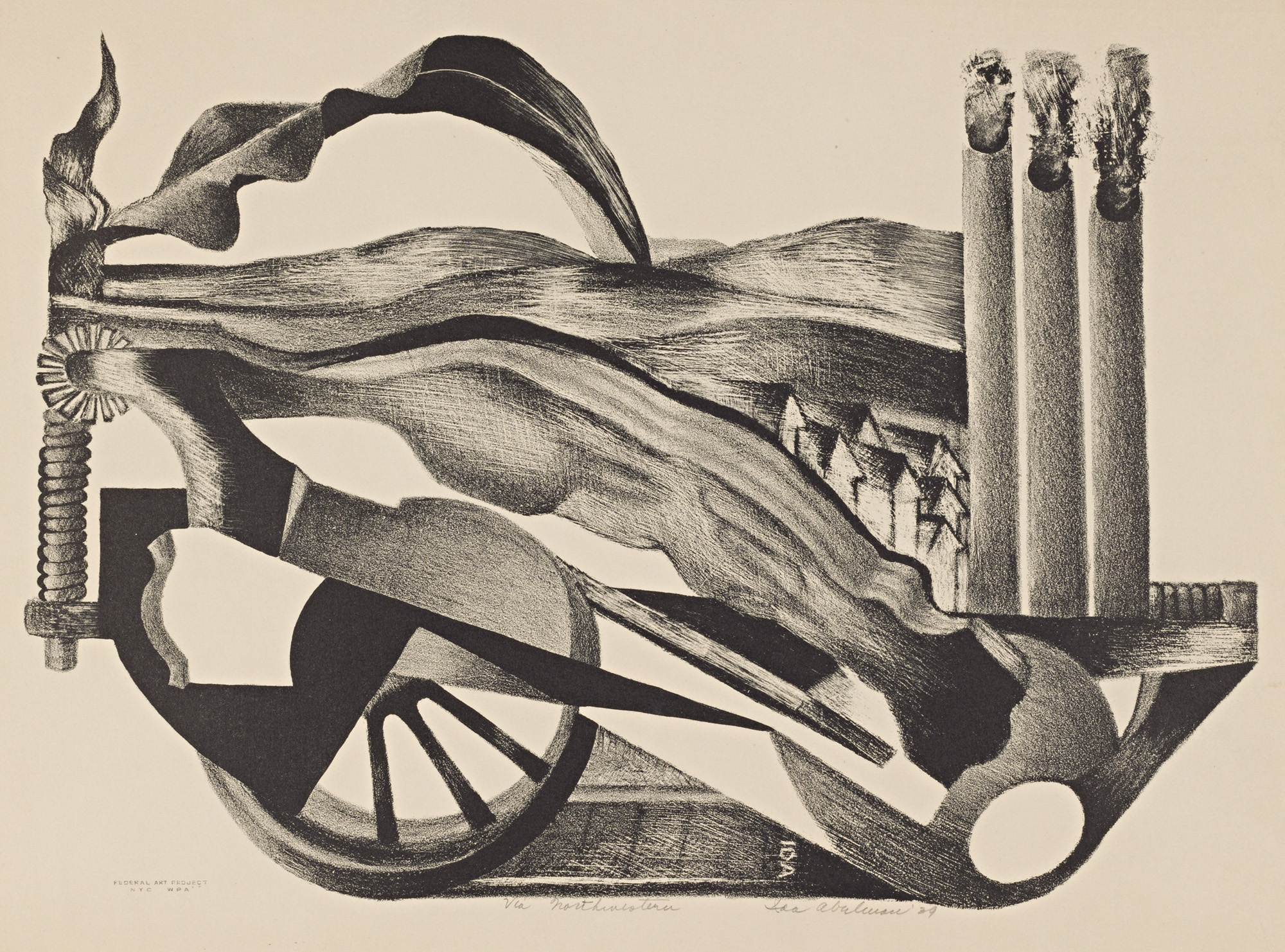
Ida Abelman (1910–2002). Via Northwestern. 1939. Lithograph. 12 1/4 x 16 in. The Marty O’Brien Collection of American Art.
Ida Abelman’s Via Northwestern (1939) reflects the artist’s sustained attention to the physical and psychological realities of modern city life during the Depression era. Active as a printmaker, painter, and muralist in New York during the 1930s, Abelman became closely associated with the Federal Art Project (FAP), through which she produced a significant body of graphic work shaped by the social and economic upheavals of the period. Educated at several New York institutions, including the National Academy of Design, Grand Central Art School, Hunter College, and the College of the City of New York, Abelman worked across a range of media, from lithography to watercolor, gouache, and tempera.
Much of her work focused on the urban poor, among whom she counted herself, and her imagery remained closely tied to the lived realities of public life in New York. Alongside her printmaking practice, she completed two public murals through the Federal Art Projects and produced more than twenty lithographs for the WPA. Via Northwestern stands as a compelling example of how artists of the 1930s adapted modernist aesthetics to depict social experience with urgency and complexity. Rather than celebrating the machine age outright, Abelman reveals the emotional and human conditions embedded within it.
Like many artists working through the Federal Art Project, Abelman grappled with the promises and contradictions of technological modernity.
Ida Abelman. Via Northwestern. Detail of 1939.
Drawing from the formal vocabularies associated with Social Realism, Constructivism, and Surrealism, her compositions frequently juxtapose industrial structures with organic or human forms, using the visual language of mechanization to explore both the promises and alienations of modern life. In addition to producing lithographs for the Federal Art Project (FAP), she completed two public murals through the WPA, both of which remain visible, and maintained close ties to leftist cultural organizations including the American Artists Congress.
Like many artists working through the FAP, Abelman grappled with the promises and contradictions of technological modernity. Her prints often incorporate bridges, subway platforms, elevated tracks, and industrial forms associated with progress and expansion, yet they rarely present these developments triumphantly. Instead, her images suggest instability as well as internal psychic pressure and fatigue beneath the surface of urban motion—even as representational figures are absent from the scene.

Ida Abelman (1910–2002). Detail of Via Northwestern. 1939.
Rather than celebrating the machine age outright, Abelman reveals the emotional and human conditions embedded within it.
In this way, Abelman resisted straightforward documentary realism. Via Northwesternd is charged with a disorienting or dreamlike atmosphere, where the mechanical structures of smokestacks and compressed houses begin to feel uncanny. This tension produces a picture of industrialization and modernity that feel at once energized and claustrophobic, reflecting broader Depression-era anxieties surrounding labor and poverty.
The lithograph is one of six Abelman works held in the Marty O’Brien Collection of American Art, alongside Wonders of Our Time (1936), Consumers (c. 1937), A Manhattan Landscape with Figures (1937), Greetings from a Manhattan Artist (c. 1939), and We Have a Claim (c. 1939). Throuhgout these works, Abelman repeatedly turned to the streets, rail lines, crowds, and industrial structures of New York as a way of examining the pressures shaping everyday urban experience.

