Roger Anliker
Round Robin, c. 1960s
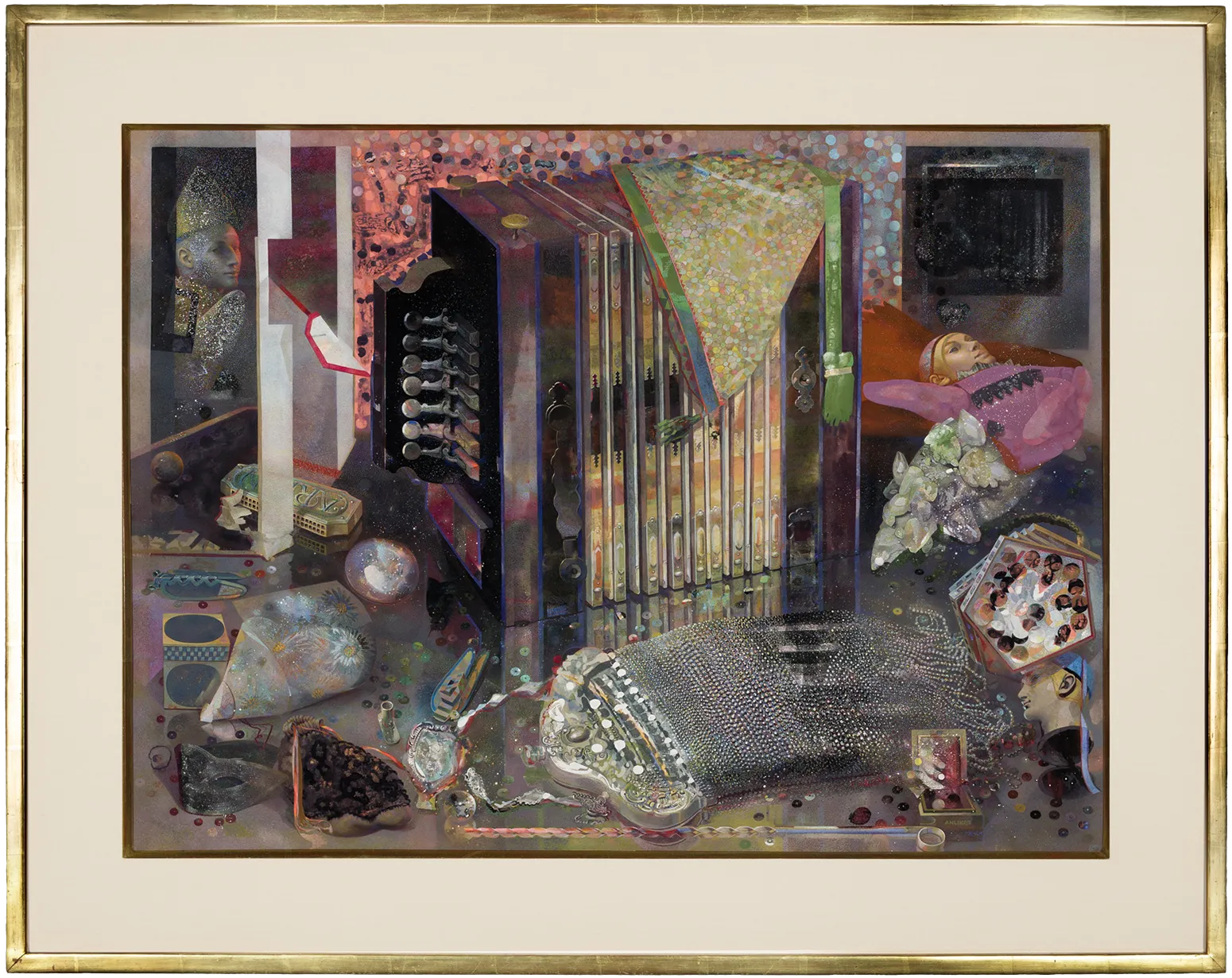
Roger Anliker (1924–2013). Round Robin. c. 1960s. Gouache on paper. Image: 22 x 29 1/2 in. O’Brien Art Foundation.
Roger Anliker’s Round Robin, painted in the 1960s, reflects the artist’s intense commitment to technical precision and his evolving approach to minimizing the visible presence of the artist’s hand. Throughout the 1960s, Anliker refined his approach to gouache, incorporating a process that pushed the limits of what the medium could achieve. Born in Akron, Ohio in 1924, Anliker received his formal training at the Cleveland Institute of Art before continuing his studies in Europe following his service in World War II. His career bridged both practice and pedagogy, first at Carnegie Mellon University where he was a professor of painting and drawing from 1948 to 1963 and later at the Tyler School of Art at Temple University, where he taught for over two decades. During his time in Pittsburgh, he mentored a generation of artists, including Andy Warhol, situating him within a broader network of postwar American art. During the postwar period, American art saw growing experimentation with artistic expression and authorship, with some artists moving away from visible gesture and toward more controlled approaches that minimized the physical presence of the artist in the finished work.

Roger Anliker (1924–2013). Detail of Round Robin. c. 1960s.
Anliker’s approach to painting reflected a broader aim of making the artist’s hand nearly invisible. Rather than emphasizing gesture or expressive brushwork, he developed a meticulous technique that minimized visible brushstrokes. By applying thin, carefully controlled layers of gouache and building up the image gradually, he created smooth transitions and subtle variations in tone without leaving obvious traces of his hand. Despite this precision, the gouache retains its own material qualities through washy, translucent passages. The medium’s opacity and capacity for delicate layering contribute to a surface that feels both carefully controlled and somewhat inscrutable, as the objects appear sharply defined yet their overlapping forms and subtle shifts in light make it difficult to fully distinguish how each was constructed. In this sense, Round Robin introduces a central paradox in his work: a painting that is meticulously constructed yet deliberately resists revealing how it was made. Executed in gouache on paper, the work reflects his interest in preserving small areas of unpainted paper to create points of light. This approach required extraordinary control, as the composition is built through the accumulation of negative space rather than the application of highlights. The result is a surface that appears almost airbrushed, even though it is entirely hand-painted.

Roger Anliker (1924–2013). Detail of Round Robin. c. 1960s.
“[Round Robin]…invites viewers into a space where observation becomes both the subject and the experience of the work itself.”
Visually, the composition presents a dense and carefully arranged grouping of objects that suggest both familiarity and subtle disorientation. The painting’s overlapping forms and subtle spatial ambiguities further contribute to this effect, creating a visual structure both cohesive and slightly unstable. In this way, Anliker blends elements of realism with a more surreal, introspective sensibility, a combination that appears throughout his work of the 1960s. Items such as an accordion, mannequin heads, a masquerade mask, and scattered personal effects create a layered environment that feels intimate and theatrical together. The arrangement evokes the aftermath of an event or performance, as though the scene captures a moment just after activity has ended. Light moves across the surface in controlled reflections and highlights, reinforcing the sense of stillness while drawing attention to the materiality of each object. At the same time, the composition resists a single focal point, encouraging the viewer to move through the image in a circular fashion.
Today, Anliker’s work is held in major institutional collections, including the Cleveland Museum of Art, the Carnegie Museum of Art, and the Butler Institute of American Art, and he remains recognized for his unique contributions to gouache and watercolor. Round Robin is one of five works by the artist in this collection, all donated by his former student and longtime steward of his legacy, Dale Roberts. Together, these works reflect not only the technical mastery that defined Anliker’s career but also his sustained exploration of constructed images. In Round Robin, this investigation invites viewers into a space where observation becomes both the subject and the experience of the work itself.

Roger Anliker (1924–2013). Detail of Round Robin. c. 1960s.
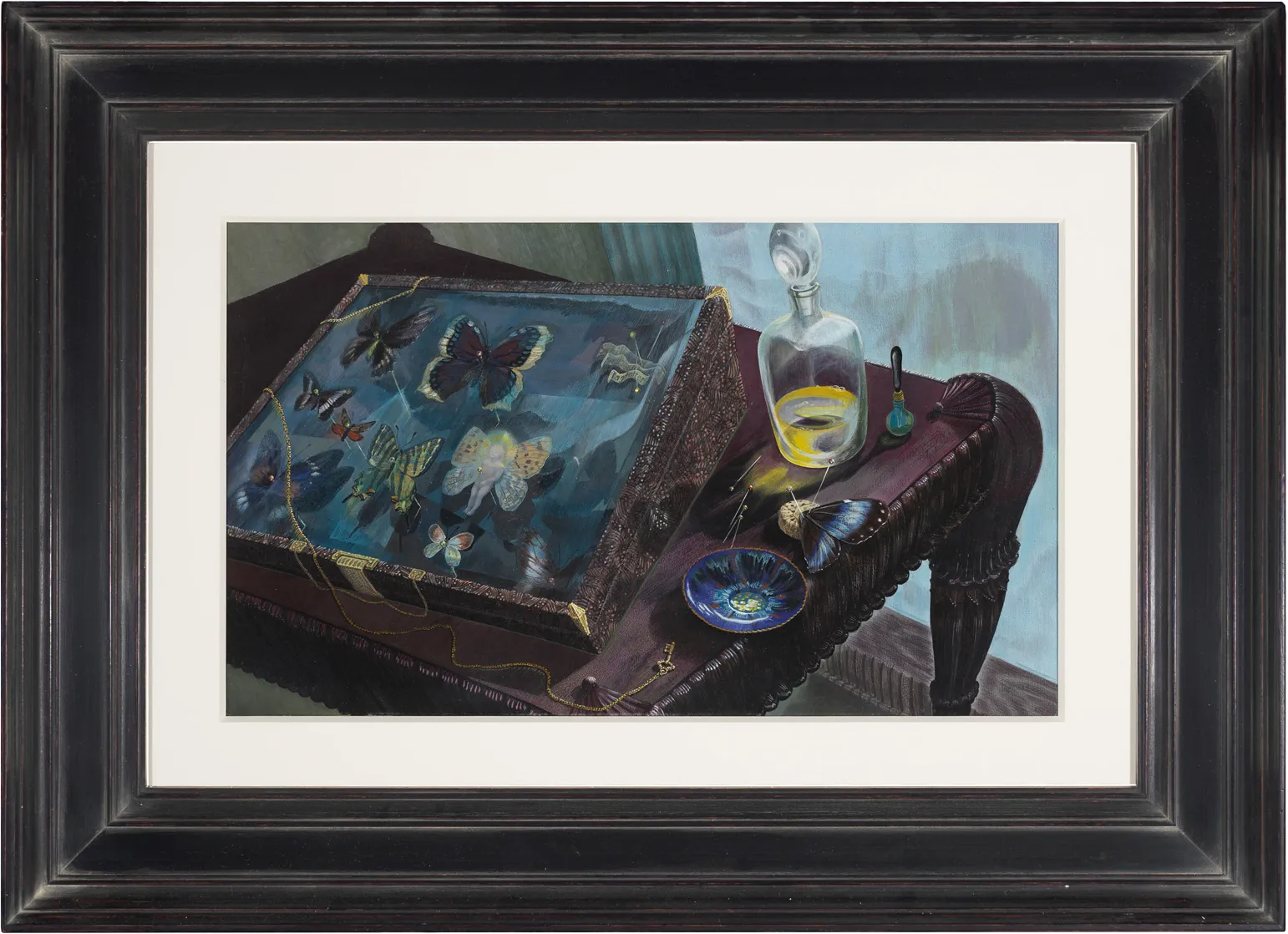
Roger Anliker (1924–2013). Untitled (Butterfly Collection). mid-1940s. Gouache on board
11 1/2 x 18 1/4 in. O’Brien Art Foundation.
His work was exhibited at major institutions such as the Whitney Museum of American Art and the Carnegie Museum of Art, where he was included in the 1955 and 1958 Carnegie Internationals. His achievements were recognized through two Guggenheim Fellowships that supported his study of European coastal environments. Across these experiences, Anliker developed a practice that balanced disciplined observation with an interest in how viewers interpret, recognize, and make sense of familiar objects when they are presented in unusual arrangements.
This Featured Artwork was authored by Research Intern, Elizabeth Marshall (M.A. Candidate, Arts Management, Carnegie Mellon University, Pittsburgh, PA).

