Sue Fuller
String Composition #44, 1953
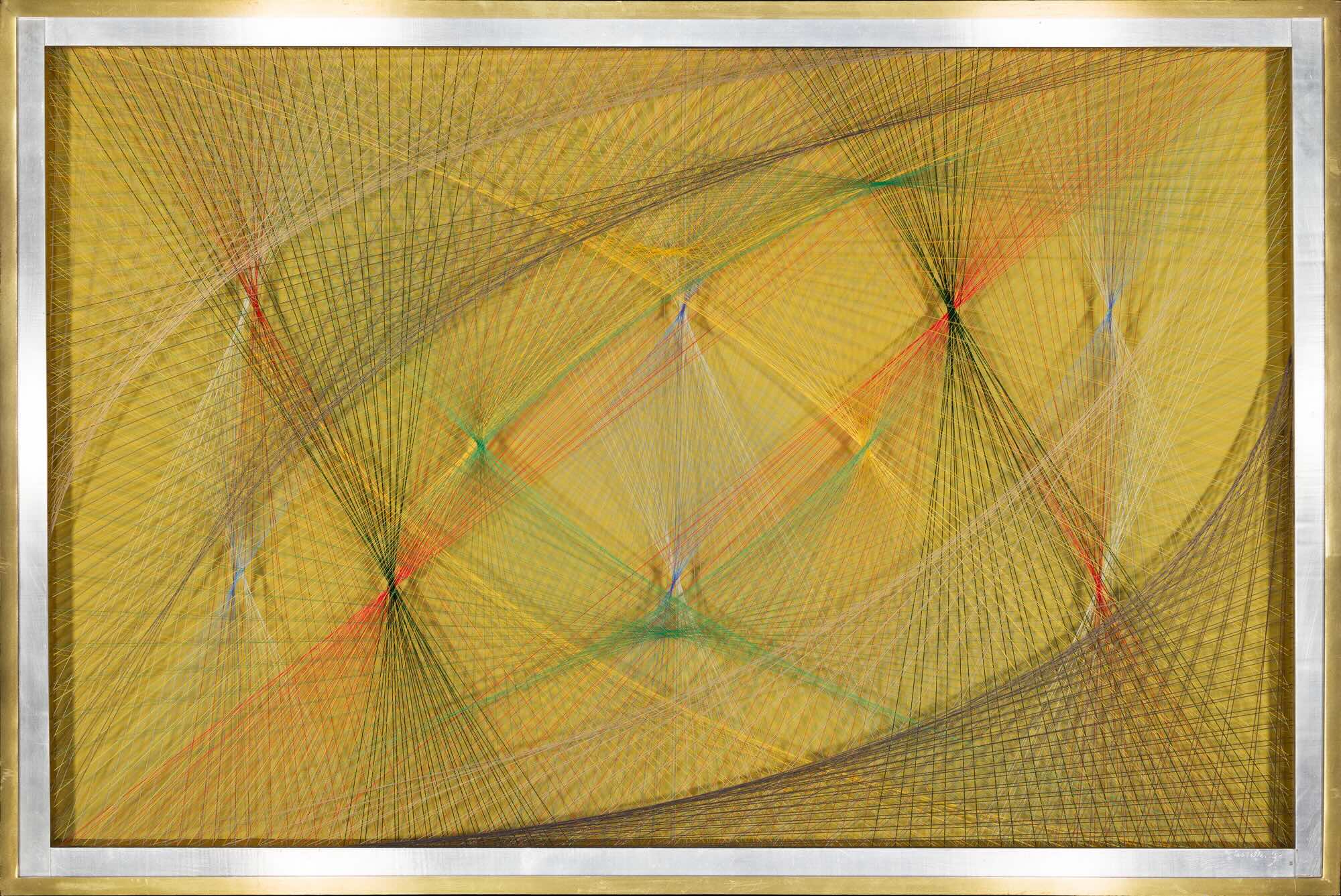
Sue Fuller (1914–2006). String Composition #44. 1953. 24 1/2 x 36 1/2 x 1 1/2 in. String on board backed with cloth and metal frame. The Marty O’Brien Collection of American Art.
The work of Sue Fuller embodies midcentury Modernism’s fascination with color and form while incorporating new dimensions of touch and material transformation. The result elevated materials once confined to “feminine” domestic craft, such as thread, into a medium of structural clarity and perceptual investigation. Born and raised in Pittsburgh, Sue Fuller first encountered modern art through the Carnegie International. She also studied at the Carnegie Institute of Technology and at Stanley William Hayter’s Atelier 17 in New York, where she absorbed the idea that experimentation itself could be more than process, but an entire mode of seeing. She was also influenced by the Constructivist logic of Naum Gabo and Antoine Pevsner as well as Bauhaus ideals of material truth and intentional experimentation, informed by her study with Josef Albers.
Yet Fuller’s work retained a singular tone: rather than imposing order on her materials, she allowed order to emerge from the nature of the works’ components. Following how thread wanted to “behave,” she learned to “draw in space” not by fixed outline but by physical material, translating pressure into rhythmic patterns of positive and negative space. In this way, the tension within her sculptures is as much conceptual as physical, threads and spatial plays of depth animated not just formally but with a sensibility that challenged expectations of what art should be.

Sue Fuller (1914–2006). Detail of String Composition #44. 1953.

Sue Fuller (1914–2006). Detail of String Composition #44. 1953. 24 1/2 x 36 1/2 x 1 1/2 in. String on board backed with cloth and metal frame. The Marty O’Brien Collection of American Art.
Fuller’s work retained a singular tone: rather than imposing order on her materials, she allowed order to emerge from the nature of the work’s components […]
In String Composition #44 (1953), differently colored threads, including of rose, violet, and ember-orange, are pulled taut across a radiant gold plane and radiate like sound waves suspended in air. The work’s original metallic frame lends an air of containment, where the work’s interior vibrates like a dance or musical instrument. More as a system of thought and feeling than pure material study, Fuller modeled frameworks that trace the intersection of intuition and geometry. Her early wool compositions evolved into intricate constructions of monofilament, nylon, and glass, each iteration refining her sense of line as energetic fields. Based not in illusion but the factual legibility of her materials, Fuller’s thread ceased to describe surface alone, extending into the volume of her compositions. In her practice, the domestic became architectural, challenging the assumptions about how women artists should make work.
Fuller’s synthesis of art and engineering reflects the technological optimism of her time, though her work resists spectacle and the sterile quality of mass production. Her pieces are quiet, measured experiments in drawing as well as depth; some of her sculptural works engage the transparency that led her to develop a method for embedding thread within clear resin, a process she patented in 1967 after years of collaboration with chemists and physicists. This innovation placed Fuller among the first artists to merge handwoven delicacy with industrial precision, bridging the language of Constructivism with the perceptual investigations of Op Art. By the 1960s, Fuller’s crystalline structures had entered major collections and exhibitions at the Museum of Modern Art, the Whitney Museum of American Art, and the Tate Gallery.