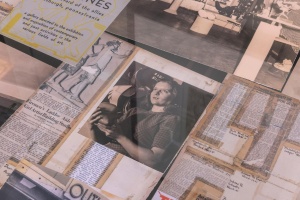
The O’Brien Art Foundation is pleased to lend several works from The Marty O’Brien Collection of American Art to Things to Come: OUTLINES, 1941–1947, an exhibition that revisits the history and impact of Outlines, a pioneering gallery of modern art, design, film, and performance active in Pittsburgh between 1941 and 1947. Almost entirely unknown today, this avant-garde hub was founded by 21-year-old Elizabeth “Betty” Rockwell (1920–1998) along the city’s Boulevard of the Allies.
Although Rockwell came from a wealthy family of Pittsburgh industry, she paved her own way, pursuing her own art before seeking to bring modern art to Pittsburgh. Long before modernism’s popular acceptance across the US, Rockwell created a radically democratic program that challenged medium hierarchies, promoted experimentation, and presented major works by modernist luminaries, unsung pioneers of abstraction, and a then-emerging generation of performance artists and filmmakers alike. With World War II looming in the background, this ethos set into motion a kind of haven for artists, both European and American, in what she described as a “public–gallery–library–theater of modern art.” Rockwell would go on to found Contemporary Craft, a local Pittsburgh organization, in 1971.
Alongside archival material from Rockwell’s scrapbooks courtesy of the Smithsonian Archives of American Art, the exhibition features artists who exhibited at Outlines, including eight works by artists from the collection: Julio De Diego, Werner Drewes, Balcomb Greene, Gertrude Glass Greene, Stanley William Hayter, Irene Rice Pereira, Jackson Pollock, and Russell Gould Twiggs. The selection specifically looks to motifs of speed or movement in conversation with modernity’s new pace of life and modernism’s visual explorations of form, line, and color. In addition to lending these works, Marty O’Brien played a key role as a board member of the Smithsonian Archives of American Art in bringing the Outlines scrapbooks and papers into their stewardship.
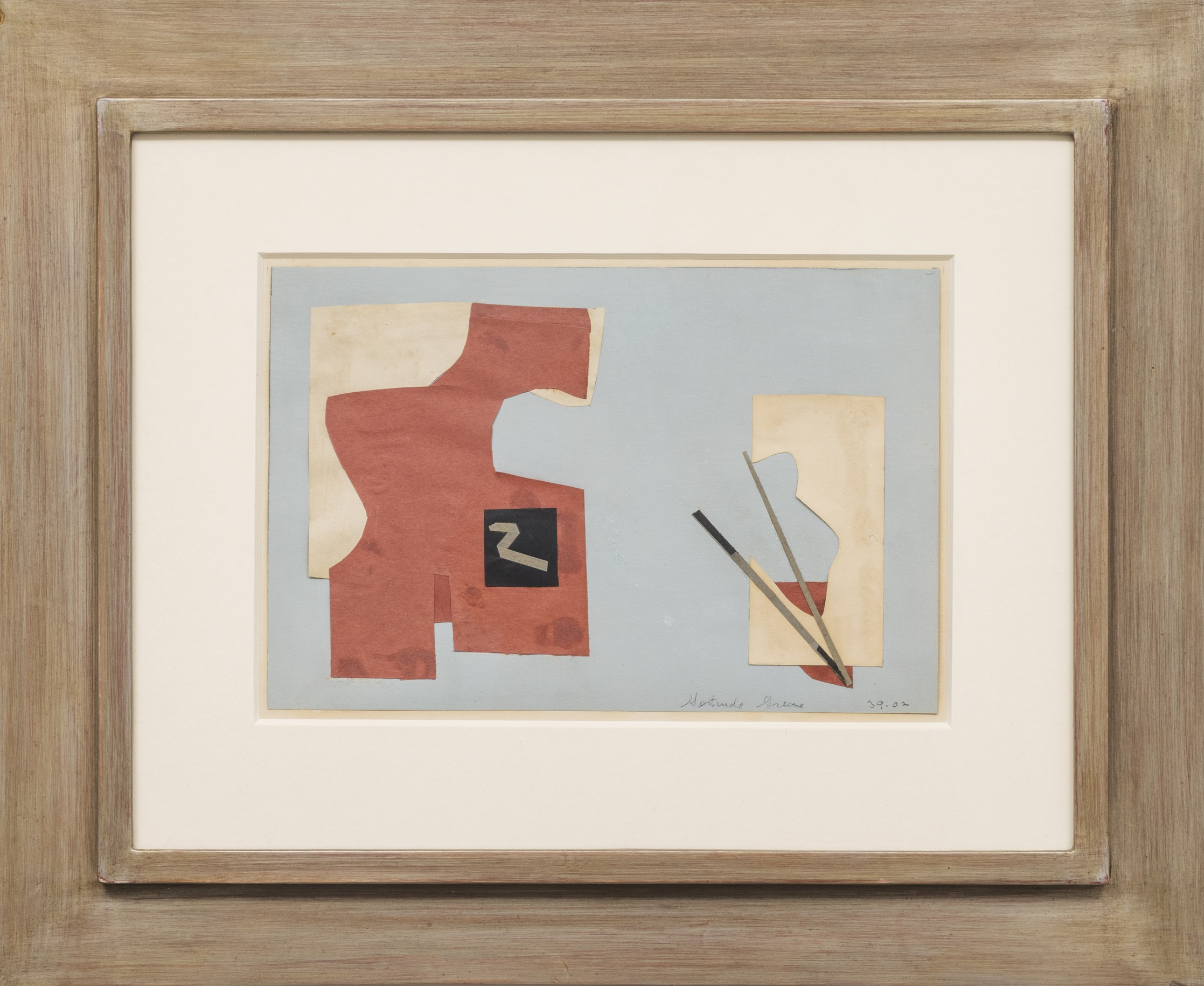
Gertrude Glass Greene (1904-1956). 39-02, 1939. Paper collage. 8 x 12 in. The Marty O’Brien Collection of American Art.

Installation view of Things to Come: OUTLINES, 1941–1947, Romance, Pittsburgh. Pictured: Jackson Pollock, Untitled CR1081 (P18), c. 1944–56; Werner Drewes, Reaching to the Moon, 1940; Stanley William Hayter, Flight 1944, 1944; Irene Rice Pereira, Formal Arrangement, 1947. The Marty O’Brien Collection of American Art. Photo: Chris Uhren.

Installation view of Things to Come: OUTLINES, 1941–1947 picturing Gertrude Glass Greene’s 39-02, 1939. The Marty O’Brien Collection of American Art. Photo: Chris Uhren.
The exhibition’s co-curators, Brittany Reilly (also Director of the Pittsburgh Modern Committee) and Margaret Kross (Director/Owner of Romance, Pittsburgh) describe the singular program:
In her unwavering vision Rockwell instigated, organized and presented six years of trailblazing exhibitions, installations, lectures, screenings, gatherings, outings and performances along with distinctly designed print collateral promoting her program […] of early sculptures and jewelry by Alexander Calder, Joseph Cornell’s rarely seen Forgotten Games box constructions, film experiments by Maya Deren, and performances by John Cage and Merce Cunningham, among many others. Several of these artists engaged chance operations and ‘non-art’ vernacular, which constituted a distinctive facet of the gallery’s program. Congruent with the Bauhaus ethos and involving its players, Outlines also blurred dimensions between creative disciplines—architecture, industrial and furniture design, functional objects, hand-craft and the graphic and advertising arts. In this environment, industrial designer-artists László Moholy-Nagy and Carnegie Mellon professor Robert Lepper exhibited and lectured; projects by Gropius and Wright, among other architectural concepts, prompted discussion; and innovative techniques by Anni Albers were showcased.
American art critic Blake Gopnik recalls in his Andy Warhol biography: “…the list of events held at Outlines is stunning, more daring than at almost any other venue in the country…this ‘gallery of tomorrow’ might as well have been a branch of the Museum of Modern Art.”
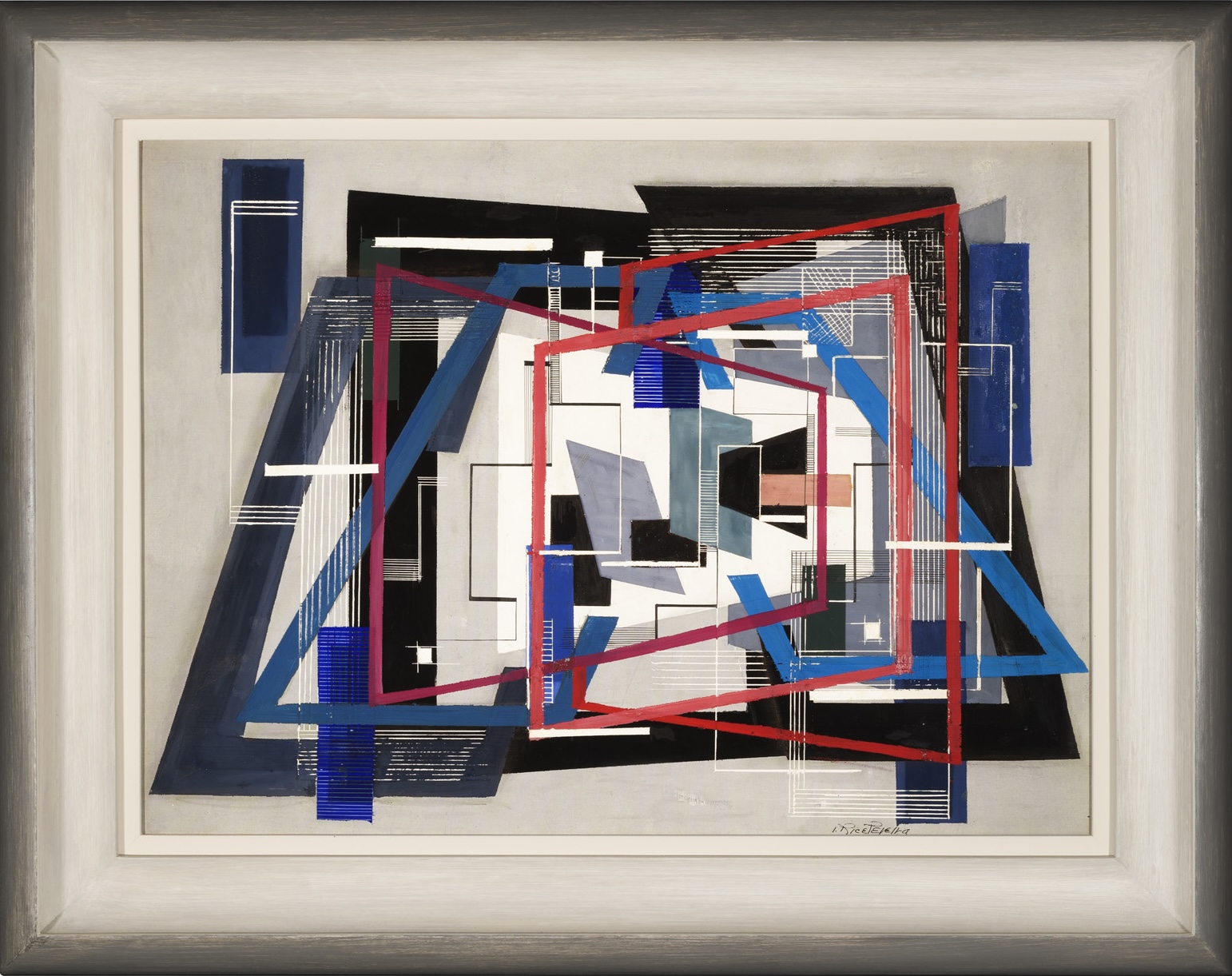
Irene Rice Pereira (1902-1971). Formal Arrangement. 1947. Gouache on paper with incisions. 24 x 30 in. The Marty O’Brien Collection of American Art.
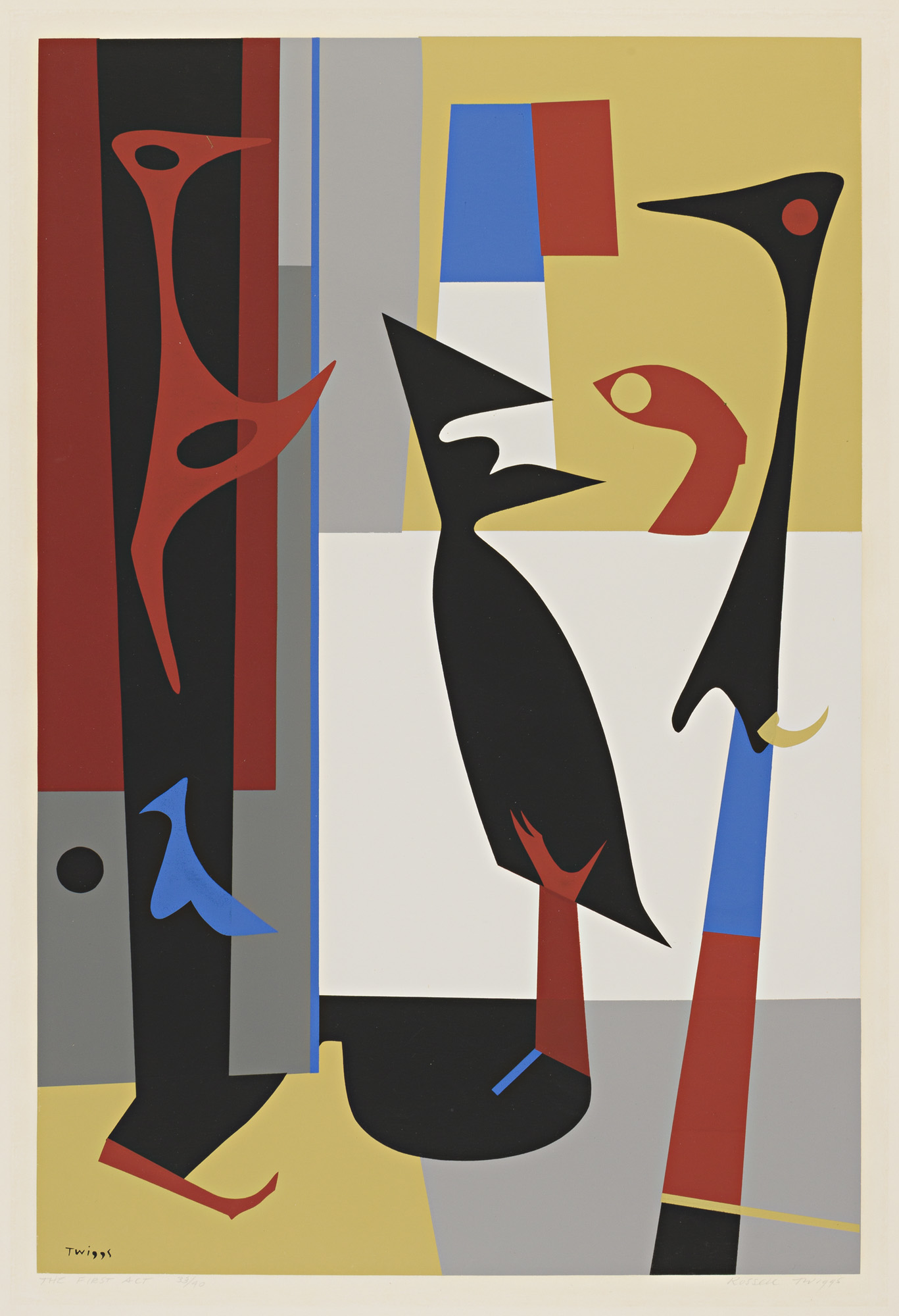
Russell Gould Twiggs (1898-1966). The First Act. c. 1950s. Color pochoir and screenprint on wove paper. 25 1/4 x 18 in.